Product education case study

Pinterest Conversions API Learning Redesign

A learning redesign that consolidated legacy Pinterest Academy Conversions API content into a clearer, role-aligned course for advertiser audiences. The work focused on reducing duplication, preserving the right technical context, and helping advertisers understand what to prepare before working with a developer or partner.

Project typeProduct education redesign
RoleContract Senior Instructional Designer / ID III
AudienceAdvertisers and business users
StatusPortfolio summary of high-level design work

Overview and business context

Advertisers need reliable conversion signals to understand campaign performance and make stronger decisions. The learning challenge was to explain a technical advertising solution at the level an advertiser needs, without turning the course into a developer implementation manual.

This document shows the thinking behind the Conversions API redesign: the audit decisions, learning structure, role alignment, and content tradeoffs. The connected eLearning prototype shows one example of how that strategy could become a learner-facing experience.

View connected eLearning prototype

Challenge

The legacy learning experience had grown across four related courses. Learners could run into repeated explanations, overlapping setup guidance, and technical depth that was not always matched to their role.

  • Reduce redundant instructional content
  • Preserve implementation context advertisers still needed
  • Clarify advertiser-owned decisions versus developer-owned setup tasks
  • Support direct integration and partner-supported setup paths
  • Make the course easier to complete, localize, and maintain

Audit and design approach

I treated the redesign as both a content audit and a learner journey problem. The audit sorted content into keep, consolidate, cut or reduce, link out, and reframe categories.

KeepConcepts that supported advertiser decision-making, preparation, data quality, setup paths, and troubleshooting.
ConsolidateRepeated explanations that could become one clearer advertiser-facing explanation.
ReduceDeveloper-heavy details that slowed completion without improving advertiser readiness.
Link outDeep technical implementation guidance better handled through documentation or handoff resources.
ReframeAccurate content that needed clearer business context, plain language, or a stronger reason why it mattered.

Final course structure

The final structure moved from four legacy courses into one streamlined course with three lessons.

Conversion VisibilityWhy Conversions API matters and how it supports conversion visibility, reporting, targeting, and optimization.
ImplementationWhat advertisers need to prepare, which setup paths may apply, and what to hand off to a developer, agency, platform partner, or technical team.
TroubleshootingCommon post-implementation issues, data quality considerations, deduplication, and when to escalate.

Result and measurement approach

The design output reduced redundant instructional content by approximately 30% and created a shorter, clearer course structure. Because this portfolio page does not reproduce gated course content or internal reporting, the result is described as a design and readiness outcome rather than a measured business impact claim.

  • Completion and drop-off by lesson
  • Learner confidence or usefulness feedback
  • Troubleshooting resource clicks
  • Reduction in repeated implementation questions
  • Maintenance effort for future product or documentation updates

Preview and downloadable source file

The preview shows the source case study document converted into a page viewer. The original DOCX and PDF version are also available.

Document page preview

Move through the preview on the page, or open a larger view.
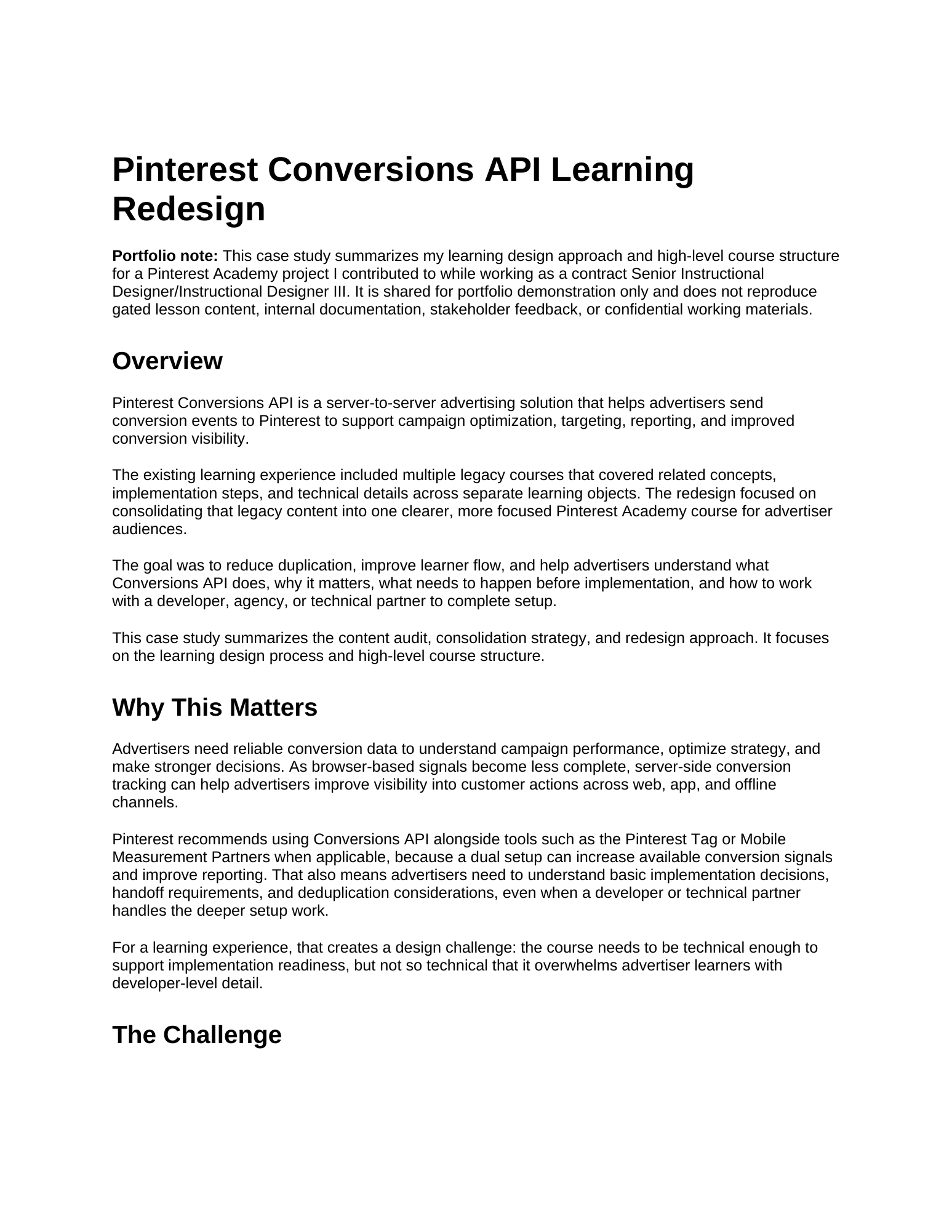
Pinterest Conversions API Learning Redesign preview 1
1 of 6

Full case study document

Download the full Pinterest Conversions API learning redesign source document with the audit, consolidation approach, final course structure, and result language.

What this demonstrates

  • Technical curriculum redesign for complex SaaS and advertising workflows
  • Content audit, consolidation, and prioritization
  • Role-aligned product education for non-developer learners
  • Judgment about what belongs in a course versus documentation
  • Global, scalable learning structure and maintainability thinking

Back to Work Samples

Return to the main portfolio to browse the rest of the project cards and supporting samples.

Back to Work Samples