Customer education operating model

Building a Scalable SME Partnership Model for Customer Education

A generalized SME partnership and recognition model designed to make customer education collaboration clearer, more visible, easier to repeat, and more sustainable across content, live learning, product consultation, and workflow validation.

Project typeSME partnership model
RoleCustomer education strategy and program design
AudienceLearning teams, SMEs, managers, leaders
StatusGeneralized confidential case study

Overview and business context

Customer education depends on accurate product knowledge, customer workflow context, and SME support. In many organizations that support happens informally, which makes it harder to request, manage, recognize, and connect back to learning quality or customer outcomes.

Problem and risk

Without a clear partnership model, SME support can become unclear side work. Learning teams may not know who to ask, SMEs may not know what good participation looks like, and managers may not see the business value or time commitment.

  • Make SME contributions easier to request and manage
  • Clarify expectations before work begins
  • Recognize meaningful contributions without requiring a large budget
  • Encourage repeat partnership without rewarding burnout
  • Give managers visibility into cross-functional contribution
  • Support better content accuracy, live learning quality, and customer confidence

Design principles and contribution model

The model separated SME participation into flexible contribution types so support could match the project need and the SME’s capacity.

Content reviewScript, storyboard, course, slide, video, demo, assessment, job aid, or post-launch correction review.
Product or workflow consultationDiscovery interviews, workflow walkthroughs, customer scenarios, use cases, risks, and misconception identification.
Live learning supportGuest speaking, co-facilitation, demo support, Q&A, office hours, webinar support, and follow-up.
Strategic supportRecurring question review, future topic recommendations, mentoring, feedback analysis, and process improvement.

Recognition and manager enablement

The recognition model used a tiered structure to acknowledge both one-time contributions and sustained partnership.

BronzeMeaningful contribution to a single project, review, live session, office hour, or defined learning activity.
SilverReliable repeat contribution across multiple projects or sessions.
GoldTrusted partnership that improves content quality, live delivery, customer relevance, or process consistency.
PlatinumLong-term partnership, mentoring, strategic input, or leadership across customer education initiatives.

Recognition options included manager notes, internal spotlights, digital badges, leadership thank-you notes, project wrap-up mentions, contribution summaries, and copy-ready performance review language.

Tracking and measurement approach

The model stayed lightweight by tracking only what was needed for fairness, visibility, recognition, and future reporting.

  • SME name, manager, team, and project supported
  • Contribution type, learning owner, date completed, and recognition tier
  • Manager notified status
  • Notes on learner, customer, workflow, or content-quality impact
  • Potential links to content accuracy, live learning quality, reduced repeated questions, or customer confidence signals

Preview and downloadable source file

The preview shows the source case study document converted into a page viewer. The original DOCX and PDF version are also available.

Document page preview

Move through the preview on the page, or open a larger view.
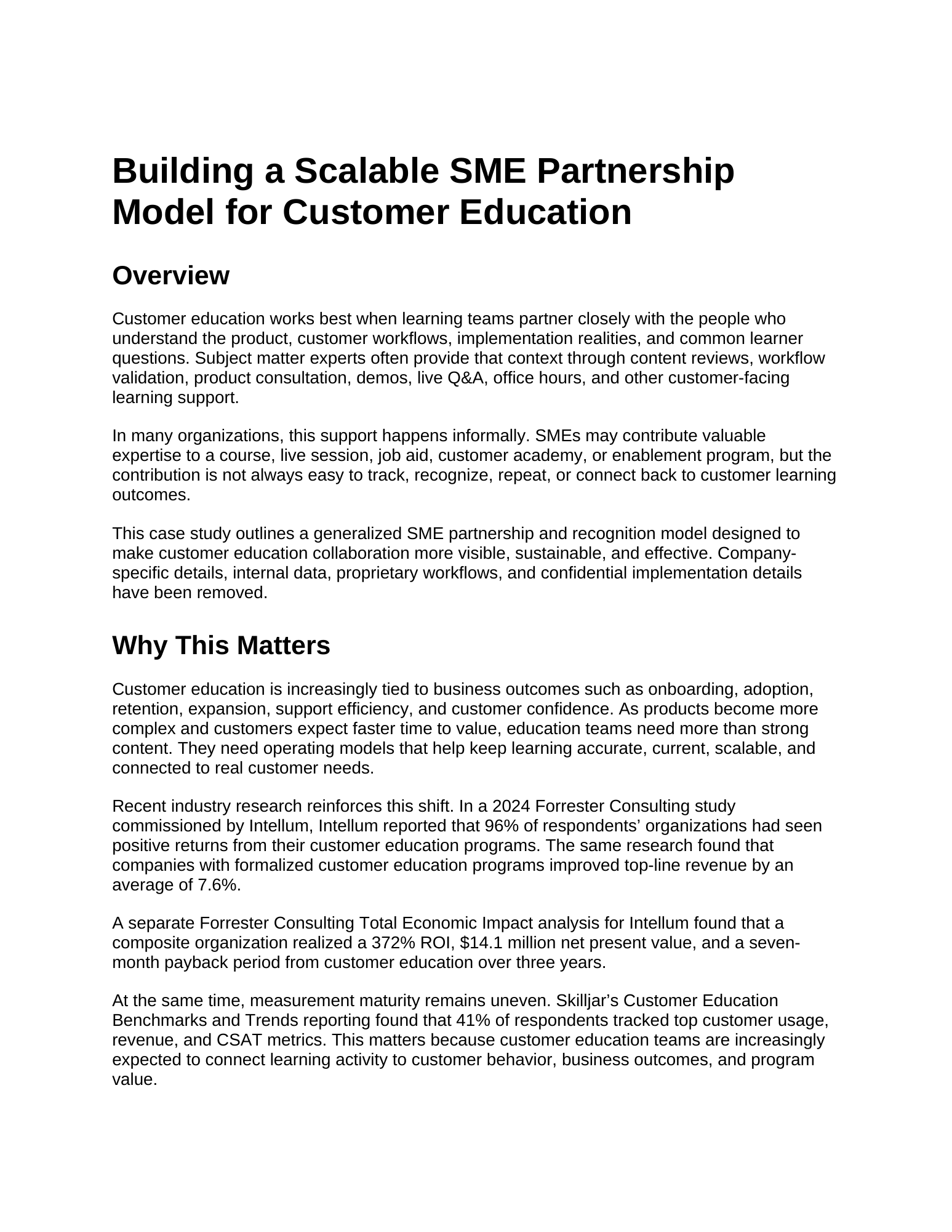
SME Partnership Model preview 1
1 of 9

Full case study document

Download the complete SME partnership model source document with the full strategy, recognition model, and measurement approach.

What this demonstrates

  • Customer education strategy beyond individual content creation
  • Cross-functional operating model design
  • SME enablement, manager visibility, and recognition design
  • Content governance and scalable knowledge-sharing practices
  • Practical systems thinking for sustainable customer education

Back to Work Samples

Return to the main portfolio to browse the rest of the project cards and supporting samples.

Back to Work Samples